




Parent
Josphat and Carolyn Kamau
Profession:
Finance / Technology company
Supply Chain Management
Age of parents:
47 and 42
Child’s name:
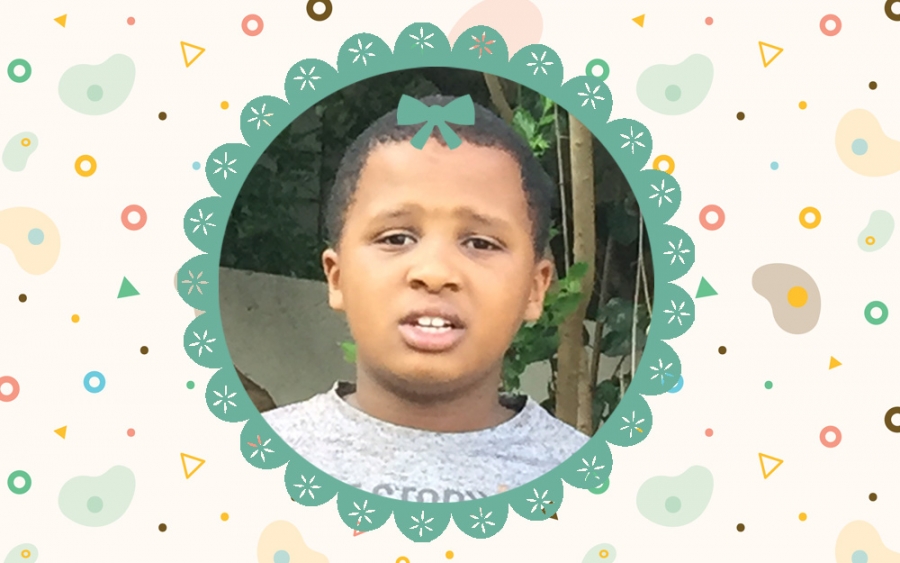
Kibogo Junior Kinyua
Age: 10 years
Is this your only child?
No, a younger brother of 5 years.
Diagnosis of child:
Obsessive Compulsive and Autism Spectrum Disorder
What are the biggest challenges facing your child on a daily basis?
• He is very hyperactive.
• He also suffers from eczema and asthma – but not chronic.
• Thinks that if he sets his mind to something regardless of the cost, he will get it.
It is a side effect of the obsessive compulsive disorder.
• Tries too hard to please. Cannot deal with negative situations – will try and correct something he has done wrong by asking you to say that he did not do wrong; so you go back to the point before he did something wrong, so that he corrects the situation. This can go on for hours, regardless of where you are. He is learning to deal with this though
What are the happiest moments you have with your child on a daily basis?
• His innocence, curiosity, wildest dreams, will say something that will have you laughing for days. Jnr always has a scheme and will try and convince you why you need something in your life, which might change to something else in a week
• Jnr and I have a routine we call “Talking about it”, every morning before he goes to school, he comes to my room and we discuss anything, which normally centers around adverse weather eg if I have ever been caught in a Tornado or Hurricane, which country has the most rain (always has to be South Africa) what astronauts do in space and what the requirements are, eg eating vegetables, not being afraid of thunder, off-road driving, my hand writing (I pretend not to be able to write properly, so that he can assist me and as a result, his hand writing has improved), why it is important for him to go to school (he loves school, so when the school bus comes to fetch him, he asks me whether I would rather stay home with him and I always say yes. Then he goes through a lengthy speech on why it is important for him to go to school – so that he can get a driver’s license, be able to get a job, become an astronaut, buy an Escalade, move to Kennedy Space Centre)
• He is very conscious of the environment and gets upset if people litter, waste water, electricity, cut trees, (he found out that back in the day, his great grandfather used to cut trees for firewood. He died before Jnr met him, which he is aware of. One day, he asked me for his cell number so that he could call him and ask him why he used to cut trees. I reminded him that he died and was now in heaven, which he said he was aware of; but that did not mean that he couldn’t answer his phone in heaven!!! I wish that was possible)
• Over exaggerating events, so that no country is better than South Africa – he will never find fault his country.
• He helps a lot around the house and even when we travel to Kenya. My mother (Jnr’s granny) is a florist and Jnr will wake up very early in the morning to make sure that flowers are delivered on time to offices, or go to the market be it at night or early morning to buy flowers.
• No fear – will stand and address anyone or any number of people – church, public functions etc
• Walking up and down the corridor clapping and humming, which he can do for hours. This is a sign that he is extremely happy
• Above all, the maturity and understanding he has on good days.
Are you married?
Married, but my husband works out of the country most of the time, so Jnr and Amani are with me most of the year.
Has your special needs child had an effect on your marriage?
Yes. Junior looks forward to talking to his dad when he is available and Jnr is not a child you talk to for a few minutes, he wants to talk for a lengthy period of time and at times, would repeat the same stories over and over. Given his father’s nature of work, talking to Jnr at times proves to be hard, as he has to work and might spare only a few minutes to talk to him. This can at times be hard for Jnr, who really adores his father, but is puzzled as to why he cannot talk to him. So to avoid this, I shield him away from his father, so that Josphat can get the opportunity to work and I ask Jnr to rather stay beside me and talk to me. Junior is normally at his best behaviour when his dad is in town, but snaps when he travels and might have one of his outbursts.
So as much as we all enjoy and love having Josphat around, it can be a bit stressful, because I know what happens to Jnr when his dad has to travel – separation anxiety. Junior takes over the role of the ‘Man of the House’ and can be overly protective towards me and his younger brother Amani. Really heart warming.
Are your family and friends supportive?
It has been tough, with Jnr being the first child, not knowing what his condition was all about and not having family around, to assist eg. when I have to make emergency trips to the ER, or have to go to work, or the caretaker doesn’t turn up on Monday morning and I have to go around looking for a place to leave him for the day.
Family and friends struggle to understand children like Jnr and think that on his bad days; he behaves the way he does because of a behaviour problem. The one person who has been a part of his life and has accepted him the way he is is his grandmother.
What I have learnt is that you will lose friends and family along the way; you cannot please everyone and raising a special needs child is not a popularity contest. No one prepares you for this and our children don’t come with a refund receipt, nor a manual on what they should or should not be doing at the age they are. With Jnr, I have learnt everything on the job from the day I gave birth to him, to the sleepless nights I had, wondering why he would cry on end with this sharp shrill, or sit infront of a washing machine and watch it spin round and round, or the emergency visits to hospital I used to make, when he would break another window with his head or wrist.
Very few people will stay around for this. I just have to be the best mother I can be to Jnr and appreciate that I have been able to raise him to the age he is at without breaking him.
On the super positive side, he lifts up the spirits of friends and family who understand him when he visits them.
• Grandma’s (the florist) arthritis disappears when he is around him and his brother
• Great-grandma has also become environmental friendly and makes sure there is no firewood outside when Jnr visits; or else she has to explain why she still cuts trees.
• Grandma’s church gives sermons about him when he attends her church.
• His cousins move into ours or grandma’s house when we travel to Kenya so that they can play and run errands with him.
What has your child taught you about yourself, both positively and negatively?
On the positive side: Taking one day at a time, having the patience to listen to and repeat the same stuff over and over, not judging especially when I see a child having a tantrum at the mall. There is more to life than material things and happiness can come wrapped in the most unusual packages. Getting help is not a sign of weakness – we were overwhelmed until we got the right school, right teachers, right doctor. Resilience is absolutely necessary- there is no refund policy with our children.
On the negative side: Most of the time I am overwhelmed as I also have his brother (Amani – 5 years) who needs my time and attention. I easily snap and can be quite defensive, plus the anxiety that there are situations in life that are beyond my control.
• Watch movies
• Travel
• Music and dancing: we are a very loud family
• Adventure seekers: we enjoy the snow and will go on a snow seeking adventure, when everyone else is running away from it, we love going on offroad and we rarely plan for our holidays, we like something, we pack and go; without knowing if we will get accommodation in the place we are going to.
• Assortment of animals (bunnies, cats , birds, fish): cleaning after them, feeding them – this has also played a big role in Jnr and Amani’s maturity and learning to be responsible
What has made the biggest difference to your child's quality of life?
• School: Although he at times gets into trouble at school, the school he currently is in will never call you to come and fetch your child, they try and deal with the situation. I still wonder how they do this, with all those children with different requirements and still be able to be that enthusiastic about their job. I always tell them that educating special needs children is a calling, no training would prepare them for the work that they do.
• Doctors: This is at times hard for parents to grasp that their children will be on medication from a young age, I also struggled to come to terms with this, but the right diagnosis, medication and therapies play a big role in the day to day life of a child with special needs
• Grandmother: Very close to him and informs her of all that is taking place at home on a daily basis. They are best buddies.
• Parents: We have learnt to accept his condition and seeking help – therapies, specialists.
• Time: He is not the same person he was last year, there is always a big change, e.g. he can write, read, dress himself, eat different types of food, has better control of his emotions; doesn’t break windows any more with his head – there is always a change and when I look back from where he has come from, it feels like a different lifetime.
What is your dream for your child?
• To be a responsible and caring person in society.
• Be an advocate for the environment as he currently is.
• To be able to accomplish his dreams or anything he sets his mind to – astronaut?
• Have a mind of his own, know what is right from wrong; not be easily influenced into negative behaviour.
• To have respect for everyone regardless of race, gender, color, background.
• Continue bringing fun and laughter wherever he goes.